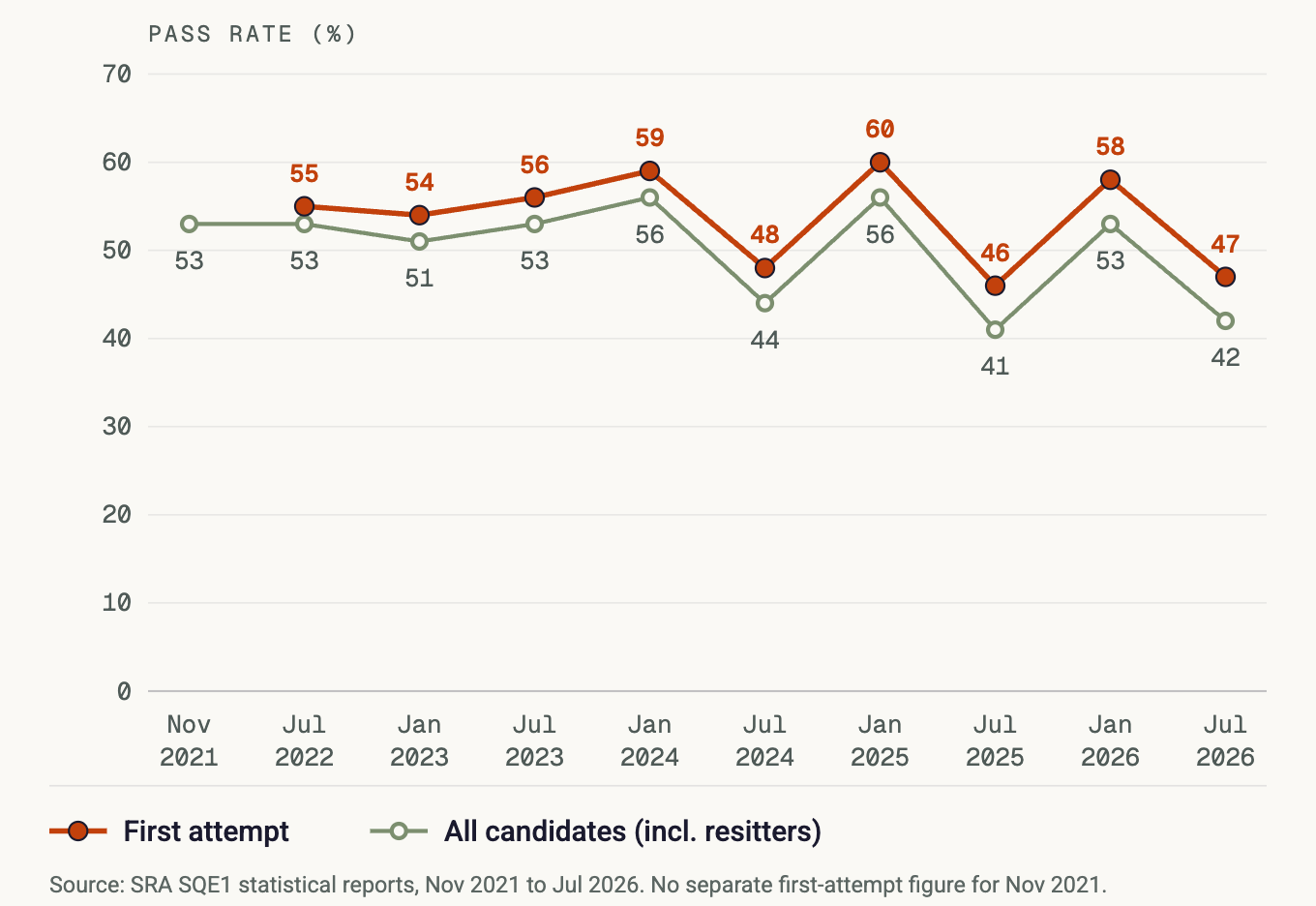
Short answer: SQE1 has run ten times since November 2021, and the overall pass rate has moved between 41% and 56%. First-time candidates do better: between 46% and 60% since July 2022, with the latest sitting (July 2026) at 42% overall and 47% first time.
This page puts every SQE1 sitting in one place, using only the SRA’s own statistical reports, results announcements and annual reports. Each figure links to the page it came from. We cover the overall pass rate, the first-attempt rate, FLK1 and FLK2, candidate numbers and the passing score, and then what the numbers do and do not tell you about your own chances in January 2027.
SQE1 pass rates by sitting
The overall rate is for candidates who sat both FLK1 and FLK2 in the same sitting. “First attempt” leaves out anyone who was resitting. The SRA did not publish a separate first-attempt figure for November 2021, but it was the first ever sitting, so nobody could have been resitting.
| Sitting | Overall pass rate | First-attempt pass rate | Candidates who sat both FLKs | Of whom first attempt |
|---|---|---|---|---|
| November 2021 | 53% | Not reported separately (first sitting) | 1,073 | Not reported separately |
| July 2022 | 53% | 55% | 1,829 | 1,736 |
| January 2023 | 51% | 54% | 3,031 | 2,827 |
| July 2023 | 53% | 56% | 3,475 | 3,005 |
| January 2024 | 56% | 59% | 6,061 | 5,580 |
| July 2024 | 44% | 48% | 5,006 | 4,168 |
| January 2025 | 56% | 60% | 6,718 graded (6,782 in total) | 5,908 |
| July 2025 | 41% | 46% | 5,851 graded (5,896 in total) | 4,736 |
| January 2026 | 53% | 58% | 7,863 graded (7,918 in total) | 6,760 |
| July 2026 | 42% | 47% | 6,260 graded (6,315 in total) | 5,012 |
From January 2025 the SRA reports a “graded” figure. It removes candidates who used an attempt but did not turn up for one of the papers without mitigating circumstances, and the pass rates are worked out on graded candidates only. The earlier reports do not make that split, so the counts are close but not perfectly like for like.
There was no January 2022 sitting. After November 2021 the next SQE1 ran from 21 July to 8 August 2022, and since then there have been two a year, in January and July.
FLK1, FLK2 and the passing score
SQE1 is two papers, FLK1 and FLK2, and you need to pass both. The SRA publishes a pass rate for each paper, for all candidates and for first-timers, plus the score needed to pass.
| Sitting | FLK1 all | FLK1 first attempt | FLK2 all | FLK2 first attempt | Passing score (FLK1 and FLK2) |
|---|---|---|---|---|---|
| November 2021 | 67% | Not reported separately | 54% | Not reported separately | 57% and 56% |
| July 2022 | 64% | 67% | 55% | 59% | 56% and 55% |
| January 2023 | 59% | 62% | 56% | 58% | 57% and 56% |
| July 2023 | 66% | 68% | 58% | 59% | 53% and 52% |
| January 2024 | 63% | 66% | 61% | 63% | 300 and 300 (scaled, out of 500) |
| July 2024 | 55% | 57% | 50% | 52% | 300 and 300 |
| January 2025 | 64% | 66% | 61% | 64% | 300 and 300 |
| July 2025 | 51% | 54% | 48% | 50% | 300 and 300 |
| January 2026 | 62% | 65% | 57% | 61% | 300 and 300 |
| July 2026 | 50% | 54% | 50% | 52% | 300 and 300 |
Sources: each sitting’s SQE1 statistical report, linked in the first table, and the SRA’s July 2026 announcement, which repeats the last six sittings. BAREX is not affiliated with any provider or with the SRA. If a figure here is out of date, email hello@barex.uk and we will correct it.
Why the passing score changed format
Up to July 2023 the reports gave the passing score as a percentage of questions answered correctly, between 52% and 57%. From January 2024 they give it as a scaled score, and the SRA says the score to pass “will always be 300” out of 500. The raw number of correct answers behind that 300 still varies from paper to paper. The SRA says there is no pre-determined pass mark: it is set for each paper to allow for differences in difficulty, so that the standard is the same at every sitting.
A lower raw pass mark, such as 53% for FLK1 in July 2023, means the SRA judged those papers slightly harder, and candidates still had to reach the same standard. The SRA explains this on its page about understanding SQE1 results.
What the numbers show
First-timers pass more often than the headline suggests
In every sitting where both figures exist, the first-attempt rate is between 2 and 5 points above the overall rate. The overall figure includes resitters, and the SRA’s annual reports show how much lower their pass rates are:
| Sitting | First-attempt SQE1 pass rate | Resit SQE1 pass rate |
|---|---|---|
| January 2023 | 54% | 14% |
| July 2023 | 56% | 29% |
| January 2024 | 59% | 16% |
| July 2024 | 48% | 20% |
| January 2025 | 60% | 25% |
| July 2025 | 46% | 20% |
| January 2026 and July 2026 | 58% and 47% | Not published yet |
Sources: SQE annual reports for 2022/23, 2023/24 and 2024/25. The 2025/26 annual report, which would cover January and July 2026, is not on the SRA’s reports page yet.
The resit figure is the SQE1 pass rate for resit candidates as a group. The picture is better for people who resit straight away after failing one or both papers. Of those who failed in January 2025 and resat in July 2025 (41% of them did), 44% passed FLK1 and 54% passed FLK2. A year earlier, the equivalent figures were 36% and 30%, from the 29% who came back in July 2024.
Since 2024, July has been the weaker sitting
For first-timers, each of the last three Julys came in 11 to 14 points below the January before it: 59% to 48% in 2024, 60% to 46% in 2025 and 58% to 47% in 2026. That gap did not exist earlier. In 2023 the first-attempt rate went up from January to July, from 54% to 56%, and July 2022 (55%) was above January 2023 (54%).
The SRA says July cohorts have a higher share of resitters, and July 2026 had the highest share yet: 23.4% of FLK1 candidates and 27.8% of FLK2 candidates were resitting. That explains part of the lower overall rate. It cannot explain the first-attempt dip, because resitters are not in that figure. The SRA has not said why July first-timers have done worse since 2024, and the reports do not give enough detail to answer it. Our July 2026 SQE1 pass rate post looks at that sitting in more detail.
FLK2 has usually been the harder paper to pass
FLK1 had the higher pass rate in each of the first nine sittings, by between 2 points (January 2024) and 13 points (November 2021). In July 2026 the two were level at 50% for all candidates, and first-timers passed FLK1 at 54% against 52% for FLK2. One sitting is not a trend, so we would not assume FLK2 has stopped being the harder paper.
The overall rate is always lower than either paper
In July 2026, first-timers passed FLK1 at 54% and FLK2 at 52%, but only 47% passed SQE1. That pattern holds in every sitting, because some candidates pass one paper and fail the other. They count as failing SQE1 overall until they pass the second paper.
The cohort is now about seven times larger
1,073 people sat both papers in November 2021. January 2026 was the largest sitting so far, with 7,918 booked on both papers. The annual reports show 13,081 people took at least one FLK paper in the 2024/25 reporting year, up from 6,545 in 2022/23. A bigger and more varied cohort is one reason to compare sittings with care.
Pass rates by background
Each sitting report breaks first-attempt results down by the answers candidates gave in the SRA’s diversity survey. Groups of fewer than 10 candidates are not reported. These are associations within a sitting. They do not show that any one factor causes a pass or a fail, and they do not predict an individual result.
Degree classification
| First-attempt SQE1 pass rate | January 2025 | July 2025 | January 2026 | July 2026 |
|---|---|---|---|---|
| First-class degree | 80% | 67% | 79% | 66% |
| 2:1 | 58% | 46% | 57% | 47% |
| 2:2 | 21% | 19% | 20% | 22% |
This is the clearest pattern in the reports. In no sitting has the 2:2 group’s first-attempt pass rate gone above 35%, and in the last four it has been 19% to 22%. The July dip shows up in the first-class and 2:1 groups as well.
Ethnicity
Every report shows a gap by ethnicity. In July 2026, first-attempt pass rates were 57% for White candidates, 51% for candidates of mixed ethnicity, 39% for other ethnic groups, 38% for Asian or Asian British candidates and 28% for Black or Black British candidates. In January 2026 the figures for White, Asian and Black candidates were 67%, 47% and 38%. The SRA has published separate research on candidate characteristics and scores, listed on its reports page. The sitting reports themselves do not explain the gap, and we do not try to here.
Qualifying work experience
There is no steady pattern. In July 2026, first-timers who had done some qualifying work experience passed at 49%, against 45% for those who had not. In January 2026 it went the other way: 50% with work experience and 62% without. We would not read anything into either result on its own.
What changes in January 2027
From January 2027 each FLK paper has 170 questions instead of 180, split into two sessions of 85, so SQE1 is 340 questions in total. The time per session stays at 2 hours 33 minutes. Each session now covers a fixed group of subjects. FLK1 session 1, for example, is Business Law and Practice, Dispute Resolution and Legal Services, with ethics tested throughout. The blueprint for how many questions each subject gets does not change. The changes apply to first-timers and resitters alike. Our guide to the January 2027 SQE1 changes sets them out session by session.
No one knows yet whether this will move the pass rate. The SRA says the standard is the same at every sitting, and the pass mark is set for each paper, so a shorter paper does not lower the bar. January 2027 results are due on 9 March 2027, and the SRA publishes the pass rates in a statistical report after that. Any forecast of the effect before then is a guess.
What to take from this
- If this is your first try, use the first-attempt figure. Over the last six sittings it has been 46% to 60%. That is a cohort average, not a forecast for you.
- Prepare for both papers together. The overall rate always sits below either paper’s rate, and a strong FLK1 will not make up for a weak FLK2.
- Count the cost of a resit. Resit candidates have passed at 14% to 29% as a group, and each part you resit costs £1,003. You have up to three attempts and six years, but it is cheaper to sit when you are ready than to book early and hope.
- Choose January or July for the study time it gives you. The SRA sets the same standard for both, and the reports do not explain the July dip. If you work full time, our guide to study hours alongside a full-time job can help you plan backwards from the exam date.
- Be careful with pass rates you cannot check. Prep providers report their own results, and the SRA statistical reports do not give pass rates by provider.
- Sit a timed, full-length mock in the new format. It will tell you more about your own position than any cohort figure. Our guide on how to pass SQE1 in January 2027 covers how to use mocks in the final weeks.
If you have not booked yet, see how to apply for SQE1 for the steps and deadlines.
Where BAREX fits
BAREX is an online SQE1 practice platform. It has SQE-style MCQs that you can filter by exam, subject, topic and difficulty, with an explanation after every answer, an AI law tutor, topic packs and cheat sheets. Its mocks follow the January 2027 format: one FLK session of 85 questions in 2 hours 33 minutes. The free plan includes one full FLK session mock, one full topic pack per subject and the AI tutor, with no time limit and no card needed. Paid plans include 12 full mocks for each FLK.
BAREX has no lectures or fixed timetable. If you want set classes with a tutor, a taught course will suit you better. You can use BAREX on its own or alongside a course. The mock is our own, not the SRA’s, and we make no pass-rate claims. You can start free on BAREX and sit a full session to see where you are.
Quick answers
What is the SQE1 pass rate?
The most recent sitting, July 2026, had an overall pass rate of 42% and a first-attempt pass rate of 47%. Across all ten sittings since November 2021, the overall rate has been between 41% and 56%.
What is the SQE1 first-time pass rate?
Since July 2022, when the SRA started reporting it separately, the first-attempt pass rate has been between 46% (July 2025) and 60% (January 2025). It was 58% in January 2026 and 47% in July 2026.
Which SQE1 sitting had the highest pass rate?
January 2024 and January 2025 share the highest overall rate, 56%. January 2025 had the highest first-attempt rate, 60%.
What is the SQE1 pass mark?
The passing score is a scaled score of 300 out of 500 for each FLK. The number of correct answers needed to reach 300 is set separately for each paper to allow for difficulty. Before January 2024 the reports gave the pass mark as a percentage, between 52% and 57%.
Do resitters pass SQE1?
Fewer do. The SRA’s annual reports put the SQE1 pass rate for resit candidates at between 14% and 29% for the sittings from January 2023 to July 2025.
Is FLK1 or FLK2 harder?
FLK2 had the lower pass rate in each of the first nine sittings. In July 2026 the two were level at 50% for all candidates.
When will the January 2027 pass rate be published?
Results are due on 9 March 2027, and the pass rates follow in the SRA’s statistical report. For July 2026 that report came out on 29 September 2026.
Sources
Pass rates and details checked on 7 November 2026 on the SRA’s SQE website. Figures are rounded as the SRA publishes them.
- SRA: SQE reports (index of all statistical and annual reports)
- SRA: SQE1 November 2021 statistical report
- SRA: SQE1 July 2022 statistical report
- SRA: SQE1 January 2023 statistical report
- SRA: SQE1 July 2023 statistical report
- SRA: SQE1 January 2024 statistical report
- SRA: SQE1 July 2024 statistical report
- SRA: SQE1 January 2025 statistical report
- SRA: SQE1 July 2025 statistical report
- SRA: SQE1 January 2026 statistical report
- SRA: SQE1 July 2026 statistical report
- SRA: July 2026 SQE1 statistical report published (29 September 2026)
- SRA: SQE annual report 2021/22
- SRA: SQE annual report 2022/23
- SRA: SQE annual report 2023/24
- SRA: SQE annual report 2024/25
- SRA: Understanding your SQE1 results
- SRA: Important changes to SQE1 for January 2027 onwards
- SRA: Assessment dates and booking windows
- SRA: How much does the SQE cost?